- Missionaryish
- Posts
- Spiritual Nutrition: Returning to the Whole Word
Spiritual Nutrition: Returning to the Whole Word
A Reflection on Processed Theology and the Means of Grace

David Ta
January 22, 2026
In partnership with


Introduction
Since moving to Oklahoma, my Reagan and I have discovered the joy of making our own bread. There's something deeply satisfying about kneading dough that comes from fresh grain, about the aroma that fills the kitchen as it bakes, about breaking open a loaf you made with your own hands. Here, with space and trees and friends who share this desire to return to older, slower ways, I've also rediscovered the joy of cooking meat with fire and wood. And the taste? There's simply no comparison. A loaf made from fresh ingredients, where the nutrients haven't decayed from sitting on shelves for months, tastes alive in a way store-bought bread cannot match. The same goes for coffee: roasted fresh from the green bean, it offers a flavor and aroma that you just cannot replicate with products that have been packaged and warehoused for who knows how long.
In an era when Americans are rediscovering the value of unprocessed foods and whole grains, grinding their own wheat and reading ingredient labels with newfound scrutiny, a parallel spiritual hunger quietly emerges. This cultural movement toward nutritional authenticity reveals something deeper: a yearning not just for physical wellness, but for the kind of spiritual nourishment that can only come from returning to the basics of faith. So what is the greatest commandment of the Law?
Love the Lord your God with all your heart and with all your soul and with all your mind. This is the first and greatest commandment.
And the second is like it: ‘Love your neighbor as yourself.’ All the Law and the Prophets hang on these two commandments.
The profound simplicity of these 2 truths stands in stark contrast to our tendency to complicate what God has made beautifully straightforward.
The Symbolism of Our Physical World
We live in a world that is symbolic in nature, where the physical realities around us often mirror deeper spiritual truths. The current war against seed oils, GMOs, and ultra-processed foods is not merely about health optimization; it represents a broader human instinct to return to what is authentic, what is whole, what is real. When King Josiah rediscovered the Book of the Law in the temple, there must have been a profound sadness that the Word of God had been lost in the very place meant to preserve it. Yet that rediscovery sparked revival. Today, as we collectively rediscover the value of whole foods for our bodies, perhaps we are being invited to rediscover the whole Word for our souls.
The “Processed” Theology We Consume
In our spiritual lives, we have become accustomed to consuming what might be called "processed theology." Like grabbing a Pop-Tart instead of preparing a nourishing breakfast, we settle for snippets of Christian content on social media, surface-level prayers, and Christian music consumed passively rather than worshipfully. These are not inherently harmful (just as eating a Clif bar will technically provide calories), but they were never meant to be our primary sustenance. They lack the rich nutrients of sitting in Scripture, meditating on God's Word, participating in corporate worship, receiving baptism and communion, and dwelling in authentic Christian community.
The theological equivalent of junk food abounds: devotional books that replace rather than supplement Scripture reading, Christian podcasts consumed without reflection, worship songs heard but not internalized, and the livestream service watched from the comfort and isolation of our homes when we are able to gather in person. We survive on these things. We even get some benefit from them. But we remain spiritually malnourished, wondering why we lack the strength to forgive our spouse after an argument, the patience to respond graciously when our children test us, or the spiritual fortitude to resist numbing ourselves with entertainment rather than facing our hearts before God.
The Means of Grace as Spiritual Whole Foods
God has instituted specific means of grace through His church: practices designed to nourish our faith continually and deeply. Other Christian traditions may use another name such as the sacraments or sacramental in nature. Because sacraments are signs. Signs and symbols to which point to the action of God’s hand. Scripture reading and meditation, corporate worship, baptism, communion, confession, prayer, and life in community are the spiritual equivalent of whole grains, fresh vegetables, and unprocessed proteins. They require more effort than their processed alternatives. You cannot passively consume Scripture the way you scroll through social media. You cannot experience true Christian community by watching a livestream alone on your couch. These means of grace demand something of us: our time, our presence, our engagement, our vulnerability.
Yet like fresh food prepared from scratch, they offer incomparable nourishment. When we spend unhurried time in God's Word, allowing it to read us as much as we read it, transformation happens. When we gather with the body of Christ, confessing our sins and celebrating communion, we receive something we cannot manufacture on our own. When we fast, creating space to hear God more clearly, our spiritual hunger sharpens and our taste for Him intensifies.
The Consequences of Spiritual Malnutrition
The effects of a poor spiritual diet reveal themselves in how we respond to life's pressures. Our inability to forgive, our impatience with loved ones, our habit of self-medication through entertainment, our persistent spiritual hunger despite constant consumption: these are symptoms of malnutrition. We have filled ourselves with the theological equivalent of empty calories, and our souls are starving for real sustenance. We wonder why we don't crave the "good food," why prayer feels like a chore rather than a delight, why Scripture seems dry rather than life-giving. But one doesn't develop a taste for nutrient-dense food while subsisting on sugar and additives. Our palates must be retrained.
A Call to Return
As we enter this new year, the cultural momentum toward better physical health creates an opportunity for spiritual awakening. If we are rethinking our diets, reordering our kitchens, and rejecting what is processed and artificial in favor of what is whole and real, should we not do the same with our spiritual lives? The answer is not found in a new program, a trendy devotional series, or the latest Christian podcast. The answer has always been available to us: return to the basics.
Clear the calendar to spend time with God. Open the Bible and read it: not skimming for a quick encouraging verse, but sitting with entire passages, entire books, allowing the whole counsel of God to shape you. Join with other believers in corporate worship, receiving the sacraments and practicing the rhythms of confession and absolution. Fast, creating space to hear the voice of God more clearly in the silence. Love your neighbor (actually, tangibly, sacrificially) as an act of worship to the God who first loved you.
Conclusion
The beauty of God's design is its elegant simplicity. Love God wholly. Love others genuinely. On these two commandments hang all the Law and the Prophets. No amount of theological processing can improve upon this foundational truth. As our culture rediscovers the wisdom of eating food in its most natural, nourishing form, may the church rediscover the wisdom of consuming God's Word in the same way: unfiltered, unprocessed, and whole. Lord, help us all to have better diets this year, both physically and spiritually. May we hunger for what truly satisfies, and may we find our deepest nourishment not in the cheap substitutes we've grown accustomed to, but in You.
Let’s go love our neighbors.
Much Love in Christ,
David & Reagan
Quick Ministry Update
Since sending our support letter on December 31st, we’ve been deeply encouraged by your responses. Thank you for the generosity and support you’ve shown.
Here’s where we stand toward our 2025 funding goal:
Total Raised: $125,100.02
Total Needed: $160,266.96
Progress: 78%
Because of those who gave and those who committed to monthly partnership, we’re able to continue building sustainable ministry infrastructure through Missionaryish Inc.—equipping Christians to share the transformative hope and love of Jesus Christ in their communities.
We’re truly grateful for every gift and every commitment.
If you’re still prayerfully considering partnering with us as we move into 2026, we’d be honored to have you join us.
All gifts are tax-deductible through Missionaryish Inc.’s 501(c)(3) status.
Not Conservative. Not Liberal. Just Christian.
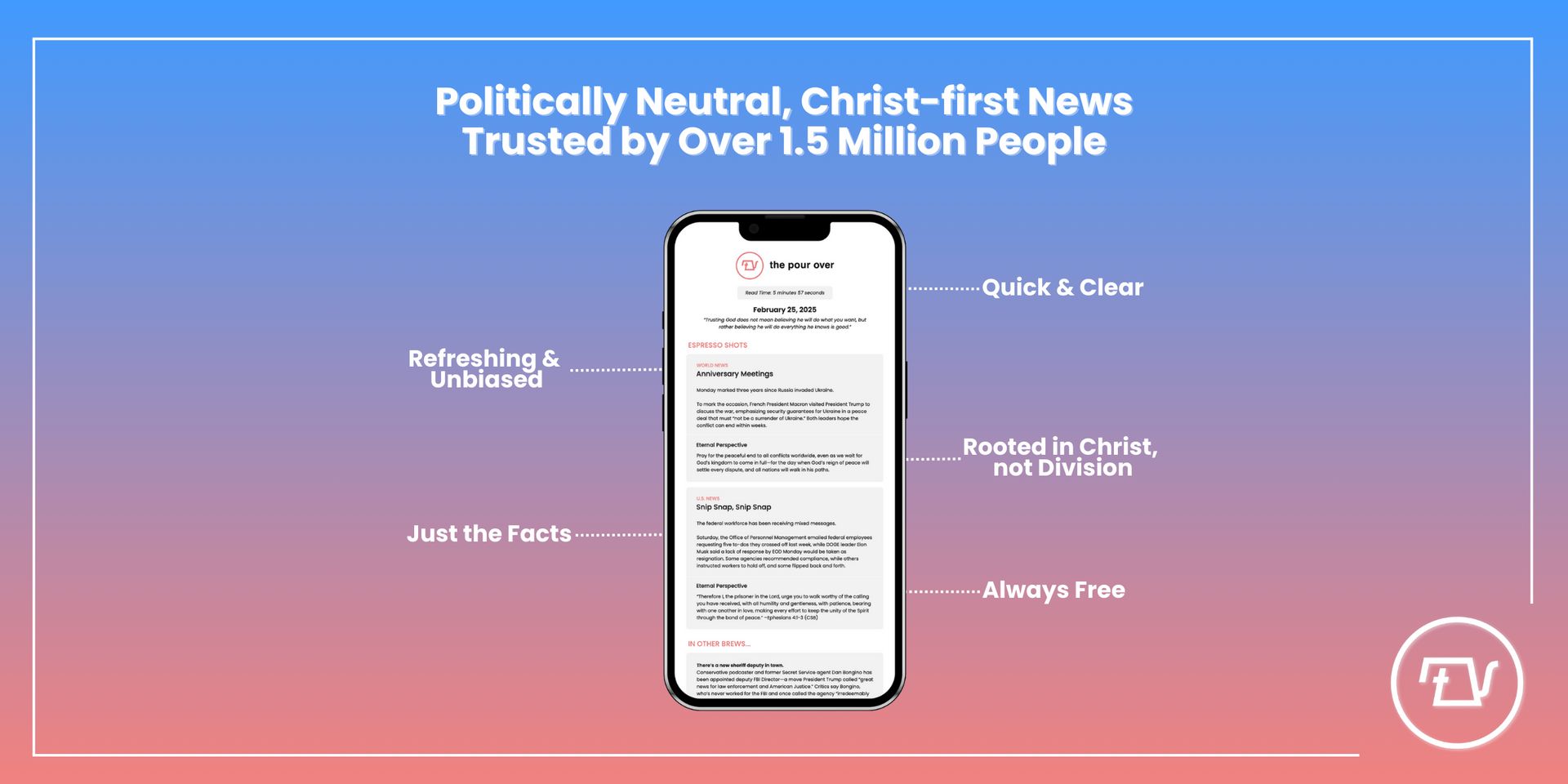
The world feels chaotic, but your news source doesn’t have to.
You can hide under a rock or spiral into the chaos… or you can subscribe to The Pour Over and get the news you need to know and the peace you crave.
Every Monday, Wednesday, and Friday, The Pour Over sends quick news summaries that are actually fun to read. Plus, each newsletter includes short biblical reminders to help you stay focused on Christ and eternity. Instead of fueling outrage or anxiety, the news becomes another prompt to rest in God and respond in faith.
Over 1.5 million Christians have ditched the doomscroll and found a better way to stay informed––Christ-first, anger-free, and (even kinda) funny.
Try it for free and check out their welcome email that’ll make you glad you did!